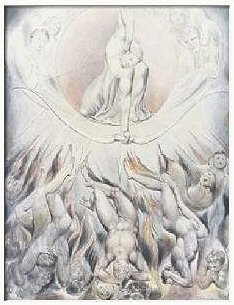

Rout of the Rebel Angels, by William Blake

A Dog Starv'd

A dog starv'd at his master's gate
Predicts the ruin of the state.
      -- William Blake,
     "Auguries of Innocence"

Thursday, October 11, 2007

How You Might Have Been Different...

...and why you shouldn't care. Love this poem. Love it. While it seems to be addressed to a male realtor, I don't think you have to be male or a realtor (or, for that matter, to be particularly religious, despite the title) to appreciate it.

It's from a collection called Practical Gods, and the poet's name is Carl Dennis.
The God Who Loves You

It must be troubling for the god who loves you
To ponder how much happier you'd be today
Had you been able to glimpse your many futures.
It must be painful for him to watch you on Friday evenings
Driving home from the office, content with your week --
Three fine houses sold to deserving families --
Knowing as he does exactly what would have happened
Had you gone to your second choice for college,
Knowing the roommate you'd have been allotted
Whose ardent opinions on painting and music
Would have kindled in you a lifelong passion.
A life thirty points above the life you're living
On any scale of satisfaction. And every point
A thorn in the side of the god who loves you.
You don't want that, a large-souled man like you
Who tries to withhold from your wife the day's disappointments
So she can save her empathy for the children.
And would you want this god to compare your wife
With the woman you were destined to meet on the other campus?
It hurts you to think of him ranking the conversation
You'd have enjoyed over there higher in insight
Than the conversation you're used to.
And think how this loving god would feel
Knowing that the man next in line for your wife
Would have pleased her more than you ever will
Even on your best days, when you really try.
Can you sleep at night believing a god like that
Is pacing his cloudy bedroom, harassed by alternatives
You're spared by ignorance? The difference between what is
And what could have been will remain alive for him
Even after you cease existing, after you catch a chill
Running out in the snow for the morning paper,
Losing eleven years that the god who loves you
Will feel compelled to imagine scene by scene
Unless you come to the rescue by imagining him
No wiser than you are, no god at all, only a friend
No closer than the actual friend you made at college,
The one you haven't written in months. Sit down tonight
And write him about the life you can talk about
With a claim to authority, the life you've witnessed,
Which for all you know is the life you've chosen.

Labels:

Tuesday, September 11, 2007

Open-Eyed Poetry

Suddenly I'm on a poetry kick. If you'd told me a couple months ago that my new blog would mention poetry in nearly every post, I wouldn't have believed you.

Anyway, a couple of poems to share. I've read (or re-read) them both, recently. And they share a certain theme, as you will see.

The Summer Day
by Mary Oliver, from House of Light

Who made the world?
Who made the swan, and the black bear?
Who made the grasshopper?
This grasshopper, I mean
the one who has flung herself out of the grass,
the one who is eating sugar out of my hand,
who is moving her jaws back and forth instead of up and down
who is gazing around with her enormous and complicated eyes.
Now she lifts her pale forearms and thoroughly washes her face.
Now she snaps her wings open, and floats away.
I don't know exactly what a prayer is.
I do know how to pay attention, how to fall down
into the grass, how to kneel down in the grass,
how to be idle and blessed, how to stroll through the fields,
which is what I have been doing all day.
Tell me, what else should I have done?
Doesn't everything die at last, and too soon?
Tell me, what is it you plan to do
with your one wild and precious life?


You Reading This, Be Ready
by William Stafford, from The Way It Is

Starting here, what do you want to remember?
How sunlight creeps along a shining floor?
What scent of old wood hovers, what softened
sound from outside fills the air?

Will you ever bring a better gift for the world
than the breathing respect that you carry
wherever you go right now? Are you waiting
for time to show you some better thoughts?

When you turn around, starting here, lift this
new glimpse that you found; carry into evening
all that you want from this day. This interval you spent
reading or hearing this, keep it for life --

What can anyone give you greater than now,
starting here, right in this room, when you turn around?

Labels:

Saturday, September 1, 2007

The Things that We Notice, The Things that We Don't

Mrs. FLJerseyBoy and I were watching some old "Seinfeld" reruns recently; these included the episode which ended Season 7 -- the episode entitled "The Invitations." This episode is famous, justifiably, as the one in which George's fiancee Susan dies from licking the flaps of the cheap wedding-invitation envelopes which George has insisted are "good enough." The envelopes, it so happens, are cheap because their glue tastes funny and isn't very strong, requiring lots of licking. That bad-tasting glue is also toxic, and hence Susan's demise. (Characteristically, George is nowhere in sight while Susan is working on the invitations.)

The audience reaction to the Big Event was so strong that it swamped attention to a Lesser But Still Notable Event, namely that Jerry had apparently found his perfect girlfriend. (This was something like the 135th episode of the show, with nearly as many girlfriends -- who almost never lasted for more than an episode -- so a perfect girlfriend was a big deal indeed.) The girlfriend in question, Jeannie, was played by actress/comedienne Janeane Garofalo. And what made the character perfect for Seinfeld's character, as he felt, was that they were so much alike.

Here's the scene where they meet. Jerry is absentmindedly walking in the street, when he is almost hit by a car; this stranger -- Jeannie -- pulls him to safety:
Jeannie: Hey! Hey! Look out. (She pulls him back.) OK! Are you okay?
Jerry: Yeah! Thanks. Oh! My God you saved my life!
Jeannie: Shouldn't there be some kind of reward for that?
Jerry: Oh! Thank you.
Jeannie: You know you should be a lot more careful crossing the street like that, otherwise you could die. If that bothers you.
Jerry: Well I...
Jeannie: You see (points to his collar)? To me this is a waste.
Jerry: What?
Jeannie: The shirt you got on under your sweater. It sits for three weeks in your drawer, waiting to come out. And when it finally does, it sticks up only half an inch out of your collar.
Jerry: I'm Jerry Seinfeld.
Jeannie: Jeannie Steinman.
Jerry: Hey! Same initials. How do you like that?
Jeannie: I like it.
As writing, this is great. It takes just a few seconds to establish that you could simply interchange the two characters' roles and even their lines. Not only can they complete each other's sentences -- they match each other's very personalities. Jeannie's abrupt dropping of the subject (that Jerry miraculously is alive and uninjured) for the sake of some trivial, superficial observation about human nature: that's classic "Jerry Seinfeld," the character.

A couple days later I came across this poem by Robert Frost, one with which I wasn't previously familiar:
A Considerable Speck
(Microscopic)

A speck that would have been beneath my sight
On any but a paper sheet so white
Set off across what I had written there.
And I had idly poised my pen in air
To stop it with a period of ink,
When something strange about it made me think.
This was no dust speck by my breathing blown,
But unmistakably a living mite
With inclinations it could call its own.
It paused as with suspicion of my pen,
And then came racing wildly on again
To where my manuscript was not yet dry;
Then paused again and either drank or smelt—
With loathing, for again it turned to fly.
Plainly with an intelligence I dealt.
It seemed too tiny to have room for feet,
Yet must have had a set of them complete
To express how much it didn't want to die.
It ran with terror and with cunning crept.
It faltered: I could see it hesitate;
Then in the middle of the open sheet
Cower down in desperation to accept
Whatever I accorded it of fate.
I have none of the tenderer-than-thou
Collectivistic regimenting love
With which the modern world is being swept.
But this poor microscopic item now!
Since it was nothing I knew evil of
I let it lie there till I hope it slept.
I have a mind myself and recognize
Mind when I meet with it in any guise.
No one can know how glad I am to find
On any sheet the least display of mind.
That's the core of it, eh? "I have a mind myself and recognize / Mind when I meet with it in any guise. / No one can know how glad I am to find / On any sheet the least display of mind." It's not just encountering someone similar that speaks to us; it's encountering their words.

A college professor with whom I was close once counseled me, in a letter, about my stupid, self-absorbed concern that my younger brother might at some point grow up to outshine me in people's estimation -- that I would come to be known as his brother, rather than the other way around. Heck, I reasoned, he was not only smart as a whip but he was athletic to boot, and I'd never been seriously interested in participatory sports. Therefore, wasn't it obvious that people would come to---

My professor's exact words are long gone now but I never forgot the gist of them:
I know [she wrote], because I've been told, that the ability to run and jump and score goals is a sign of intelligence and character. But I know, because I've seen it and felt it and watched it happen, dozens of times over, that the ability to write proves it.
(My brother, by the way, is -- like most of us in our generation -- no longer an athlete. But he is still smart as a whip and every day shines in ways that I couldn't hope to, professionally and personally... just as I do in ways that he can't. We do love each other.)

And then, for some reason, having encountered both the "Seinfeld" episode and the Frost poem within a couple days, and having thought -- apparently at random -- of my professor's words, I started to think about (get ready for the thud of an anticlimax) right-wing broadcasters and columnists, who these days far out-shout the whimpers of the "biased mainstream liberal media." What makes these idiots so successful?

What makes them successful is two-fold:
  • They can honestly (much as I hate to admit it) write. Not only can they write "correctly," in complete sentences and with proper punctuation. But they're also skilled in manipulating the symbols of patriotism, of Old-Testament godliness and sanctity, of other virtues originating decades or even centuries and millennia ago. Thrift. Hard work. Ruggedness. And so on.
  • They employ that gift with language in ways that their audiences wish that they could, while asserting the substance that their audiences believe to their core. They are like their audiences (at least, their public faces are), but even better.
Ain't language a wonderful thing? I had this Big Idea for a novel, years and years ago. The Big Idea was that God turns out to be language. It's ubiquitous, we are not fully human without it (sorry, opposable thumb). And boy do we pay it tribute, every day, every waking (and nearly every sleeping) minute.

Labels: , , , , ,

Monday, August 13, 2007

Welcome to A Dog Starv'd

As you can see from its description, I've cribbed this blog's name from William Blake's "Auguries of Innocence." This is the long (by contemporary standards) poem which begins, famously:
To see a world in a grain of sand,
And a heaven in a wild flower,
Hold infinity in the palm of your hand,
And eternity in an hour.
Not quite the smiley-faced hymn to all things beautiful and miraculous that these opening lines prepare us for, the poem as a whole is a savage indictment of a society which places way too much stock in the wrong things. The complete text can be found numerous places around the Web, including this page from the Academy of American Poets, and -- as you can see there -- is often presented as a single massive block of 132 lines. More readable versions (like this one) break it up into couplets and/or quatrains, which makes it easier to absorb the force of Blake's vision -- and its relevance to early 21st-century America. E.g.:
A truth that's told with bad intent
Beats all the lies you can invent.
...
The strongest poison ever known
Came from Caesar's laurel crown.
Nought can deform the human race
Like to the armour's iron brace.
And so on.

These lamentations and warnings alternate, roughly, with assertions more in keeping with the tenor of the opening four lines -- assertions such as these:
Joy and woe are woven fine,
A clothing for the soul divine.
Under every grief and pine
Runs a joy with silken twine.
...
One mite wrung from the lab'rer's hands
Shall buy and sell the miser's lands;
Or, if protected from on high,
Does that whole nation sell and buy.
Despite my choice of epigraph, I'm not going to use ADS as a soapbox strictly (or even mostly) for political pronouncements. I've tried that before (as you can see, in all its broken-imaged glory) and found it impossible to sustain this kind of single-purposed howl across more than a few months at a time. But Blake's poem does provide a good sense of proportion for me and, I hope, for ADS: outrage, balanced with wonder; finger-shaking, countered with embraces; things that I hate, as well as things that I love.

We'll see how it goes.

Labels: , , , ,