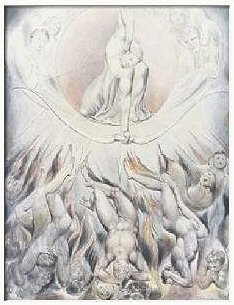

Rout of the Rebel Angels, by William Blake

A Dog Starv'd

A dog starv'd at his master's gate
Predicts the ruin of the state.
      -- William Blake,
     "Auguries of Innocence"

Thursday, March 20, 2008

Great Old Protest Songs Never Die, They Just Recycle (Over and Over and Over Again)

"Eve of Destruction," says Wikipedia,
is a grave warning of imminent apocalypse, and considered by some to be the epitome of a protest song.
Oh yeah. It's all that, and then some.
On one of public TV's recurring orgies of '60s-music-driven pledge drives, last night I caught Barry McGuire (now 40 years older, of course) performing it in a voice which, if anything, is even more drenched in an agony of disillusion than in the original recording. (Time does some things right, especially to some singers' voices.)
The Wikipedia article linked above includes a 30-second sample -- not much. I'll try to give you a little more later, when I'm at a desktop better equipped for audio processing. For now, here are the song's lyrics:

Eve Of Destruction
(as recorded by Barry McGuire, 1965)

The eastern world it is explodin',
violence flarin', bullets loadin',
you're old enough to kill but not for votin',
you don't believe in war, what's that gun you're totin',
and even the Jordan river has bodies floatin',

but you tell me over and over and over again my friend,
ah, you don't believe we're on the eve of destruction.

Don't you understand, what I'm trying to say?
Can't you see the fear that I'm feeling today?
If the button is pushed, there's no running away,
There'll be no one to save with the world in a grave,
take a look around you, boy, it's bound to scare you, boy,

but you tell me over and over and over again my friend,
ah, you don't believe we're on the eve of destruction.

Yeah, my blood's so mad, feels like coagulatin',
I'm sittin' here, just contemplatin',
I can't twist the truth, it knows no regulation,
handful of Senators don't pass legislation,
and marches alone can't bring integration,
when human respect is disintegratin',
this whole crazy world is just too frustratin',

and you tell me over and over and over again my friend,
ah, you don't believe we're on the eve of destruction.

Think of all the hate there is in Red China!
Then take a look around to Selma, Alabama!
Ah, you may leave here, for four days in space,
but when you return, it's the same old place,
the poundin' of the drums, the pride and disgrace,
you can bury your dead, but don't leave a trace,
hate your next-door-neighbour, but don't forget to say grace,

and you tell me over and over and over and over again my friend,
ah, you don't believe we're on the eve of destruction.

Aside from some of the dated references (Red China, four days in space), the sonofabitch holds up pretty well, doesn't it?
Truth be known, it's a little depressing to consider how readily the content still fits. Are the problems that intractable? Can so many people see, so easily, what the problems are in the first place, be so committed to fixing them, and yet be so incapable of breaking the old patterns?
This is one of the most important things fueling the Obama campaign's success. I have yet to make up my mind about him, 100% (I was an Edwards fan). But the harping by critics on what they deem an inappropriately style-over-substance appeal misses the point. That point is: Enough. We've had enough.
I don't say his opponents should roll over and let him take it without a fight, but I am saying they're supremely misguided. If their cynicism masquerading as "hard-nosed practicality" and "realism" comes to triumph over Obama's strange amalgam of charisma and goose-bumping rhetoric and plain old hope, it's a safe bet you'll see "Eve of Destruction" pop up its desperate head in another couple-three-four decades.

Update 2019-02-15:
The Internets being what they are, none of the original means I'd provided to listen to the song now work reliably -- or at all -- anymore. So why don't we do this the easy way: here's Barry Maguire on Youtube.


Labels: , , ,

Thursday, November 29, 2007

Krazy Kaptioning - Part 1: Macy's Parade

[Closed captioning. Ever use it? If you're hearing-impaired, or live with someone who is, you almost certainly have had the experience. It's great, alerting even normally-hearing people to sounds and dialogue that they couldn't otherwise hear. That said, there are still some (mostly amusing) aspects to it. I'm expecting this to be a regular feature here, hence the optimistic "Part 1." We'll see!]

When I was growing up, when my hearing was less of an issue, I loved watching parades on TV. The Macy's Thanksgiving Day parade, of course, but also (because this was in the Greater Philadelphia area) the Mummers' parade, and so on. Marching bands, y'know. Baton twirlers. The smiling faces of the crowd, flushing pink in the cold air and in the excitement and anticipation of whatever the holiday might bring.

Something happened in recent years, though, which has made the parade-watching TV experience very strange. I'm speaking of the Macy's parade in general here, and in particular of the Broadway-number performances that now make up the bulk of the "parade" (even though the performances occur when the performers are not parading, but planted statically in the street outside the department store).

By the time this nouveau tradition set in, my hearing was already at the point where -- unaided -- the sound pretty much reached my ears in this sort of amorphous wall of sound. I could see the pretty girls, and the handsome guys, and also some pretty guys, smiling smiling smiling. But the general effect of the sound was, like:
muted muted muted
louder louder louder
HIGH NOTE,
HIGH NOTE
,
muted muted muted...
and so on.

So last week I'm watching the parade. Or rather, the TV is on in the living room, and I'm making the same pie I've made for 20 years: sour-cream pumpkin, and periodically going through the living room on some feline-related task, or whatever. The sound, however, is not on -- and the closed captions are. And that's when I realize the other big change that's happened in recent years -- namely, the apparent dessication of Broadway song-writing talent.

Yes, yes, I know. The Macy's parade isn't where you should expect to find extremely clever, baroquely interwoven lyrics. But really now.

One of the acts (and God and the families of all these young people please forgive me) in particular made me stop and stare at the lower half of the screen, unable to believe that the captions really said this:
We're... making magic!
Making magic!
Making magic!
We're making magic!
I kid you not. Man, I can't tell you how much I wish I'd turned the sound on, and the captions off, before encountering that clunker of a lyric. Lerner and Loewe must be spinning in their graves.

Labels: ,

Thursday, November 1, 2007

The Hinge Around Which a Song Swings

So-called 'hinge note': partial screen capture from Audacity audio editor, showing a portion of 'Je M'Ennuie'I'm not, Lord knows, a musician. But I do like to listen to music, and every now and then I can't help noticing something interesting.

I've been listening to one of my and Mrs. FLJerseyBoy's favorite soundtrack albums, from the 1991 film Henry and June. As you may know, the action in the film takes place in France (Paris, mostly) during the 1920s. (For purposes of this blog entry, that's really all you need to know about the film. If you're interested in finding out more about it, of course, you can always check the Internet Movie Database, and/or Wikipedia.)

Given the time and place, it's only natural that the soundtrack consist of 80-year-old music, whether by the original performers (like "I Found a Million-Dollar Baby," sung by Bing Crosby) or updated but still in keeping with the film's context and tenor.

Among the updated items on the soundtrack is the thirteenth, called "Je M'Ennuie." (Translated to English, this is, literally, "I'm bored." Perhaps it's got some idiomatic nuance beyond that, if you use the phrase in France.) This is a laaaaaaaannnguorous instrumental, arranged by Mark Adler for a trio: a throaty muted trumpet in the foreground, intro and background by a piano, and very subtly, for the most part, a drummer using brushes on the cymbal. It's that "for the most part" which interests me -- or rather, the exceptions to the rule.

When I started listening to this song the other day, I was in the car, alone, and sitting at a traffic light. Languor aside, it's a quite melodic tune, and it's easy to get into the gentle swing of it. It's also hard to ignore that trumpet, which is given such a major role that you almost forget the other instruments are there.

A little less than a minute into the song, the pitch is swinging like an autumn leaf in still air, groundwards: back and forth, down and down. And then all of a sudden something amazing happens: in the space of less than a second, everything stops, is silent, and the drummer wakes up and taps, very lightly, on his cymbal.

When I heard this the other day, my face broke into a big grin. I'm not sure why. The closest I've come was when I described the epiphany to Mrs. FLJerseyBoy; I referred her to the Mad Hatter's tea party in Alice in Wonderland. The following excerpt is from the book's Chapter 7; the Dormouse has been asleep (although occasionally singing or otherwise interjecting, while not really waking up) during the whole party:
"Suppose we change the subject," the March Hare interrupted, yawning. "I'm getting tired of this. I vote the young lady tells us a story."

"I'm afraid I don't know one," said Alice, rather alarmed at the proposal.

"Then the Dormouse shall!" [the Mad Hatter and the March Hare] both cried. "Wake up, Dormouse!" And they pinched it on both sides at once.

The Dormouse slowly opened his eyes. "I wasn't asleep," he said in a hoarse, feeble voice: "I heard every word you fellows were saying."
That's what the drummer is like at this point in the song: he suddenly wakes up, claims to have been participating all along, and immediately falls back into a slumber. At that point, the trumpet and piano -- but especially the trumpet -- goes right back up to the top of the stairs and begins another swinging descent, to a repeat of the whole cycle.

The illustration at the top of this post is a partial screen capture taken from the Audacity sound editor program; it shows a segment of the song, from about 1:36 into it and running to 1:40 or so. This is the second appearance of the suddenly conscious drummer (not the one which hit me in the car); the cymbal tap is that last flare in the wave, to the right, just to the right of that fat bump of a note (and subsequent silence) from the other two members of the trip.

If you'd like to hear a sample which includes this "hinge note," I've got one in three formats:
This sample actually includes not only the portion illustrated above, but a decent section before it -- starting at around 1:25 -- to give you an idea of the "falling leaf" effect and the general rhythm and tone of the song. Here's the, uh, waveform -- is that the word? (like I said, IANAM) -- of the full sample, from which the illustration at the top is taken:
(As above, but depicts a longer sample)

Labels: , ,